Molecular Plant
19 December 2025
Duet between stress granules and glutathionylation regulates cytosolic redox state to maintain proteostasis in Arabidopsis
Shuai Zhao1,2,6,8, Zhouli Xie1,2,3,4,8, Xiaoyuan Chen1,8, Yabo Shi1,5, Haiwei Li6,7, Ying Li1,2, Changtian Chen1,2, Mian Zhou6,7 and Wei Wang1,2,
1 State Key Laboratory for Gene Function and Modulation Research, School of Life Sciences, Peking University, Beijing 100871, China
2 Center for Life Sciences, Beijing 100871, China
3 Hubei Hongshan Laboratory, Wuhan 430070, China
4 National Key Laboratory for Germplasm Innovation & Utilization of Horticultural Crops, The Center of Crop Nanobiotechnology, College of Plant Science & Technology, Huazhong Agricultural University, Wuhan 430070, China
5 Joint Graduate Program of Peking-Tsinghua-NIBS, Academy for Advanced Interdisciplinary Studies, Peking University, Beijing 100871, China
6 College of Life Sciences, Capital Normal University, Beijing 100048, China
7 Beijing Key Laboratory of Plant Gene Resources and Biotechnology for Carbon Reduction and Environmental Improvement, Beijing 100048, China
8 These authors contributed equally
10.1016/j.molp.2025.12.018
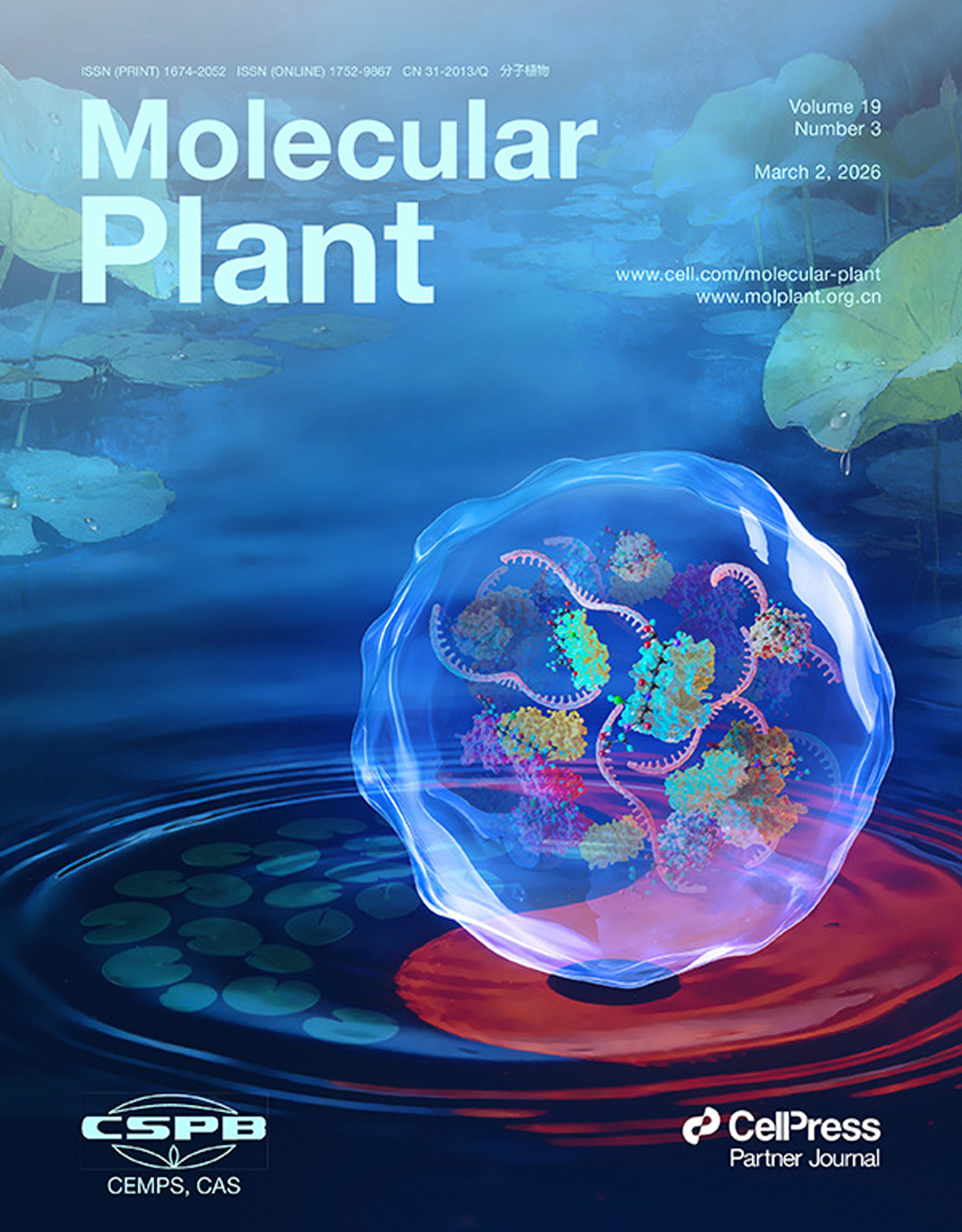
The Yin-Yang of redox balance: protein S-glutathionylation and stress granules safeguard proteostasis. Inspired by the lotus pond of Weiming Lake at Peking University, the cover highlights protein S-glutathionylation (Pr-SSG) as a key driver of stress granule (SG) formation under oxidative stress. At the base of the image, the Yin-Yang ripples on the water surface symbolize the dynamic equilibrium between oxidation and reduction within the cytosol, with floating green duckweeds representing the stabilizing force of the reductive state. While the rising oxidative milieu (represented by the reddish ripples) acts as an essential trigger for stress signaling, it concurrently poses a severe threat to protein integrity. Emerging from the oxidizing milieu, a dew-like SG condensate assembles as Pr-SSG promotes multicomponent interactions and phase separation, concentrating RNAs and proteins into a transient protective compartment. Together, the visual elements convey a profound biological strategy. Pr-SSG and SGs synergistically construct a transient, reducing microenvironment—a cellular “safe haven”. This localized compartment buffers against oxidative damage, effectively maintaining cytosolic proteostasis while allowing necessary stress signaling cascades to proceed unimpeded.
Anhui Province Academy of Science and Technology, No. 128,Wanshui Road, Hi-Tech Zone, Hefei City, Anhui Province, China
 +86 17354022649
 service@sondii.com


 IPv6 network supported
Our hours
Beijing time: 9:00-18:00