《Jun 2025 Volume 46Issue 6》
Yiran Tao1,4 ∙ Ying Lu1,4 ∙ Bin Yu2 ∙ Yuxi Wang1,3
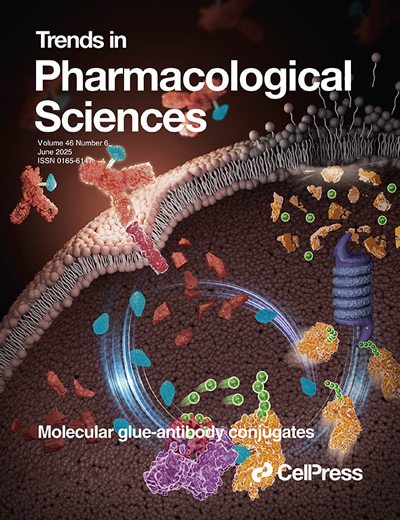
The cover of this issue of Trends in Pharmacological Sciences features the work “Molecular Glue Meets Antibody: Next-Generation Antibody–Drug Conjugates” by Yiran Tao, Yuxi Wang, Ying Lu, and Bin Yu.
Research Background
Antibody–drug conjugates (ADCs) have revolutionized the field of oncology by enabling the targeted delivery of cytotoxic therapeutics. However, several persistent limitations continue to restrict the broader therapeutic potential of ADCs, including the limited diversity of payloads. In addition, the emergence of drug resistance mechanisms has created new challenges for the clinical efficacy of ADC-based therapies. To overcome these obstacles, researchers have begun exploring innovative payload strategies, leading to the development of molecular glue–antibody conjugates (MACs). By employing molecular glues as payloads, MACs provide a novel approach to addressing the current limitations of conventional ADCs.
Research Significance
Molecular glue–antibody conjugates (MACs) offer several remarkable advantages and represent a breakthrough advancement in this field. Due to the catalytic and event-driven properties of molecular glues, MACs have the potential to achieve enhanced therapeutic efficacy. Compared with traditional ADCs, MACs may reduce off-target effects, improve treatment safety, and ultimately enhance the therapeutic index. Currently, two MAC candidates have already entered clinical trials, further validating their promising clinical potential. This progress not only introduces new possibilities for cancer therapy, but also offers renewed hope for improving patient outcomes and quality of life.
Research Outlook
This study provides an in-depth discussion of the mechanisms, recent advances, and the potential of molecular glue–antibody conjugates (MACs) to surpass traditional ADCs and molecular glues alone. Despite their exciting promise, MACs still face multiple developmental challenges. Future research should focus on further elucidating their mechanisms of action and optimizing their design and synthesis strategies to improve stability and efficacy. In addition, several critical issues remain to be addressed, such as achieving more precise control over molecular glue release and minimizing immunogenicity. With continued scientific advances and technological innovation, MACs are expected to play an increasingly important role in cancer therapy, paving the way for more effective anticancer treatments and driving the next generation of oncology therapeutics.
Anhui Province Academy of Science and Technology, No. 128,Wanshui Road, Hi-Tech Zone, Hefei City, Anhui Province, China
 +86 17354022649
 service@sondii.com


 IPv6 network supported
Our hours
Beijing time: 9:00-18:00